
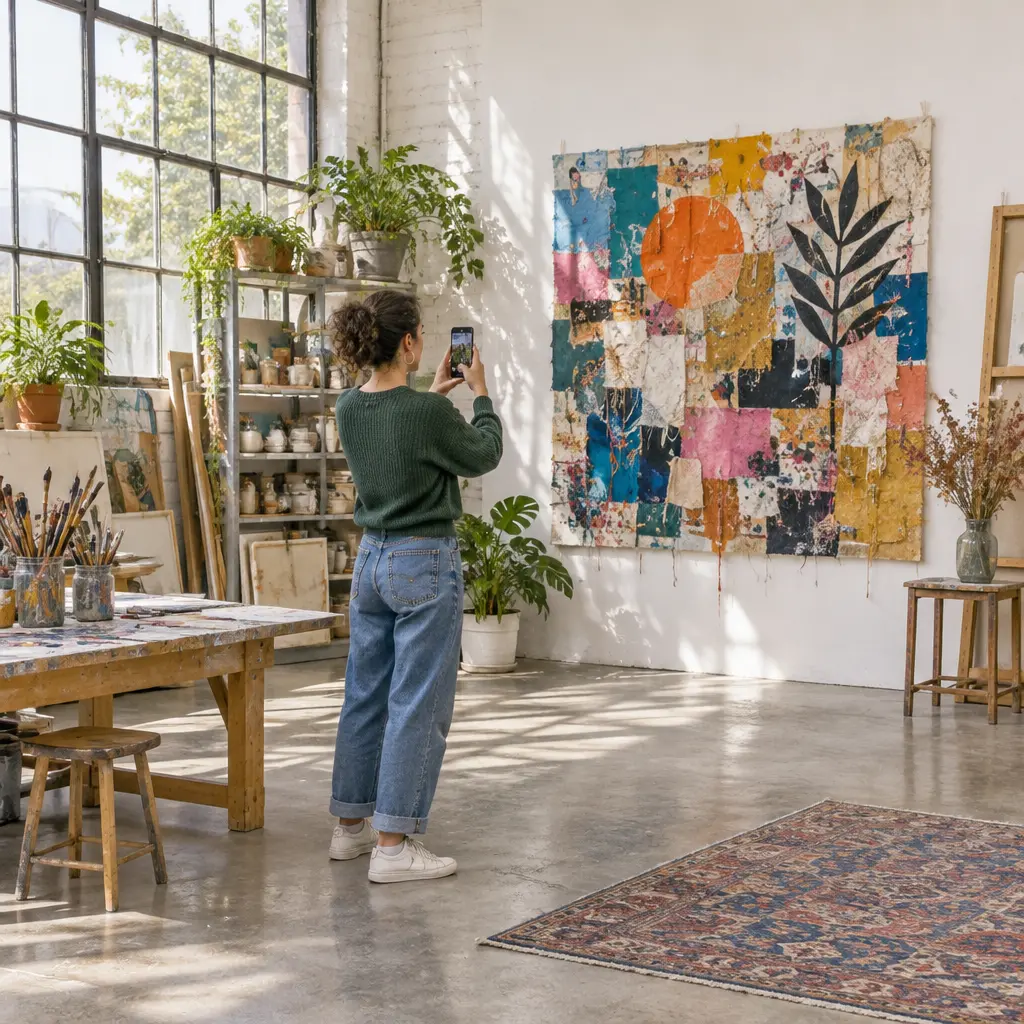
Social media shapes unconventional art by changing how artists make, circulate, and interpret work that falls outside established artistic norms. Platforms such as Instagram, TikTok, and YouTube let artists share experimental forms directly with audiences, while recommendation systems and engagement metrics influence which work becomes visible. The effects are substantial: DataReportal estimated that 5.24 billion people used social media worldwide in January 2025. This article examines how platforms enable unconventional art, reshape discovery and audience participation, and create new tensions around visibility, ownership, and creative freedom.
Social Media Enables Unconventional Art Creation
Unconventional art refers to creative work that challenges familiar materials, formats, subjects, or expectations about who can be an artist and where art belongs. The term covers practices such as digital collage, meme art, augmented-reality filters, performance streamed online, and collaborative works made by dispersed participants. There is no single authoritative definition; art historians and institutions commonly describe avant-garde and experimental practices in terms of their challenge to established conventions. Social platforms extend that impulse by supplying accessible tools for making and sharing work beyond traditional galleries and publishers.
The scale of social media helps explain its relevance. DataReportal’s Digital 2025 Global Overview reported 5.24 billion social-media user identities in January 2025, while cautioning that identities are not necessarily unique individuals. For artists, this creates the possibility of reaching audiences across geography and institutional boundaries, though actual reach depends on platform design, access, and audience behavior.
Low-cost digital experimentation
Digital experimentation is the use of accessible software, phones, and platform features to test artistic ideas without relying on specialized studios or distribution networks. Artists can combine photographs, animation, text, sound, and user-interface elements into works that are native to a feed or short-form video. The result may be an artwork, a process record, or both: drafts and edits become visible parts of the creative practice.
This accessibility does not mean that all artists have equal opportunity. Devices, reliable internet, time, technical skills, and platform access remain unevenly distributed. Still, UNESCO’s 2022 report Re|Shaping Policies for Creativity emphasizes the importance of digital transformation to cultural and creative sectors, including the new routes digital tools create for production and distribution.
Platform-native and hybrid art forms
Platform-native art is made to use a platform’s particular conventions, such as vertical video, looping clips, filters, captions, or audience responses. Hybrid art combines online and offline elements—for example, a mural documented through a time-lapse series, a gallery installation that uses a social-media feed, or a performance whose audience participates through comments.
These forms expand what can count as an artwork and where it can be encountered. They also make context important: a short video may be understood differently when viewed in a gallery, in a feed, or after being reposted without its original caption. Social media therefore does not merely carry unconventional art; its formats can become part of the artistic material.
Social Media Transforms Unconventional Art Discovery
Art discovery is the process by which people encounter and identify creative work. Social platforms change discovery through hashtags, search, sharing, creator networks, and recommendation systems. Rather than relying solely on museums, critics, or commercial galleries to select work, audiences can encounter art through peers and platform feeds. This can broaden access, but it also transfers some gatekeeping power to privately operated systems.
Hashtags, sharing, and audience networks
Hashtags and reposts help users find work associated with a topic, style, community, or event. Artists can also build direct relationships with followers, receive feedback, and connect with collaborators without first securing institutional representation. The Pew Research Center’s 2024 report on social-media use among U.S. adults found that YouTube and Facebook remained among the most widely used platforms, while use of services such as Instagram, TikTok, and Reddit varied by age and other demographic factors. These differences matter because an artist’s audience is shaped by where particular communities spend time.
Online networks can be especially significant for artists whose work is overlooked by mainstream institutions or whose communities are geographically dispersed. A shared image or performance can travel across borders quickly, helping niche practices find interested viewers. Yet a large potential audience is not the same as guaranteed exposure: discoverability depends on language, timing, network size, and platform rules.
Recommendation systems and algorithmic visibility
Recommendation systems rank and suggest content using signals such as viewing behavior, interactions, and other platform-specific data. They can introduce unfamiliar artists to people outside their existing follower base, but their operation is not fully transparent to creators or the public. The European Commission’s Digital Services Act requires very large online platforms to provide information about their recommender systems and offer certain users options that are not based on profiling, reflecting wider concern about how automated ranking affects access to information.
For unconventional art, algorithmic visibility creates a trade-off. Work that is immediately legible, emotionally striking, or easy to watch may perform better than work that depends on extended context or slow attention. Artists may adapt their presentation to platform conventions, even when those conventions conflict with their aims. A useful accompanying chart would compare the same artwork’s reach across formats—such as a short clip, a process post, and a long-form explanation—while noting that platform analytics measure attention imperfectly, not artistic value.
Social Media Expands Unconventional Art Participation
Participation describes how audiences contribute to, respond to, or help circulate an artwork rather than only viewing it. Social media makes these exchanges immediate through comments, duets, remixes, challenges, and collaborative prompts. In this environment, the boundary between artist and audience can become more flexible, although the artist still determines how contributions are incorporated and credited.
Remix, collaboration, and participatory work
Remix art reuses or transforms existing material, while participatory art invites audiences to shape the work or its interpretation. Short-form video features such as duets and stitches, along with image editing and audio reuse, make these practices easy to circulate. A creator might invite viewers to reinterpret a drawing, add a verse to a sound, or submit images that become part of a collective collage.
These practices connect to longer histories of appropriation, sampling, and collaborative art, but online circulation makes attribution and permission more complicated. The U.S. Copyright Office explains that copyright protection generally applies to original works of authorship fixed in a tangible medium, while fair use is assessed case by case through statutory factors. Reuse is therefore not automatically lawful simply because a platform provides a remix feature; creators should consider permissions, licenses, credit, and the context of use.
Community formation and cultural representation
Online communities can provide artists with peer support, shared references, and spaces to present perspectives that receive limited attention in conventional art institutions. They can also help audiences interpret work through discussion and lived experience. The social value lies not only in the artwork’s reach but in the relationships and conversations formed around it.
At the same time, online visibility can expose artists to harassment, appropriation, or unwanted attention. Platform moderation may remove work inconsistently, and content policies can affect artistic expression, particularly when work addresses bodies, politics, or marginalized identities. Community-building therefore requires attention to safety, consent, accessibility, and the ability to moderate interactions.
Social Media Creates Risks for Unconventional Art
The same systems that make unconventional art easier to distribute can make artists more dependent on commercial platforms. Accounts can lose reach, features can change, and content can be removed under policies artists may not control. Social-media success is also often measured through views, likes, and follower counts, which are indicators of platform activity rather than reliable measures of artistic quality or long-term cultural influence.
Ownership, attribution, and platform dependence
Ownership concerns arise when artwork is copied, reposted without credit, or used beyond the creator’s intended context. Platform terms may grant services permissions needed to host and distribute user content, while creators generally retain rights they hold under applicable law. Artists can reduce some risks by keeping original files, documenting publication dates, using clear licensing statements, and maintaining an independent portfolio or mailing list alongside social accounts.
Platform dependence also affects artistic continuity. When an account is suspended or a recommendation system changes, an artist may lose a major route to audiences. A resilient approach treats social media as one part of a wider practice that can include exhibitions, archives, newsletters, community spaces, and direct sales.
Metrics, attention, and creative pressure
Engagement metrics quantify actions such as views, likes, comments, saves, or shares. They can help creators understand audience response, but the pressure to publish frequently or reproduce a successful format may narrow experimentation. A work that develops slowly, resists easy interpretation, or depends on physical presence may not translate well into a rapidly scrolling feed.
Artists can use metrics as limited feedback rather than as a final judgment. Comparing audience responses across formats, documenting creative goals, and separating personal artistic criteria from platform performance can help preserve experimentation. For researchers and cultural organizations, a useful graph would distinguish reach, meaningful interaction, and sustained engagement rather than presenting a single view count as proof of impact.
Conclusion
Social media shapes unconventional art through creation tools, discovery systems, participatory features, and platform rules. It enables low-cost experimentation and hybrid forms, connects artists with audiences outside traditional institutions, and supports remix and community collaboration. At the same time, recommendation systems, ownership disputes, moderation, and engagement pressures can constrain creative freedom and make visibility unstable.
Artists can benefit from treating platforms as both creative materials and imperfect distribution channels: document work, credit collaborators, review licensing choices, and maintain ways to reach audiences beyond a single service. Readers can support unconventional art by following creators directly, sharing work with attribution, and engaging with the ideas behind the images. Further research should examine how platform changes affect artists over time and whether online visibility leads to durable opportunities, fair compensation, and broader cultural representation.
Sources: DataReportal, Digital 2025: Global Overview Report, https://datareportal.com/reports/digital-2025-global-overview-report; UNESCO, Re|Shaping Policies for Creativity: Addressing Culture as a Global Public Good, 2022, https://www.unesco.org/reports/reshaping-creativity/2022/en; Pew Research Center, Americans’ Social Media Use, 2024, https://www.pewresearch.org/internet/2024/01/31/americans-social-media-use/; European Commission, Digital Services Act: Questions and Answers, https://digital-strategy.ec.europa.eu/en/faqs/digital-services-act-questions-and-answers; U.S. Copyright Office, Copyright Basics, https://www.copyright.gov/circs/circ01.pdf; U.S. Copyright Office, Fair Use, https://www.copyright.gov/fair-use/.