
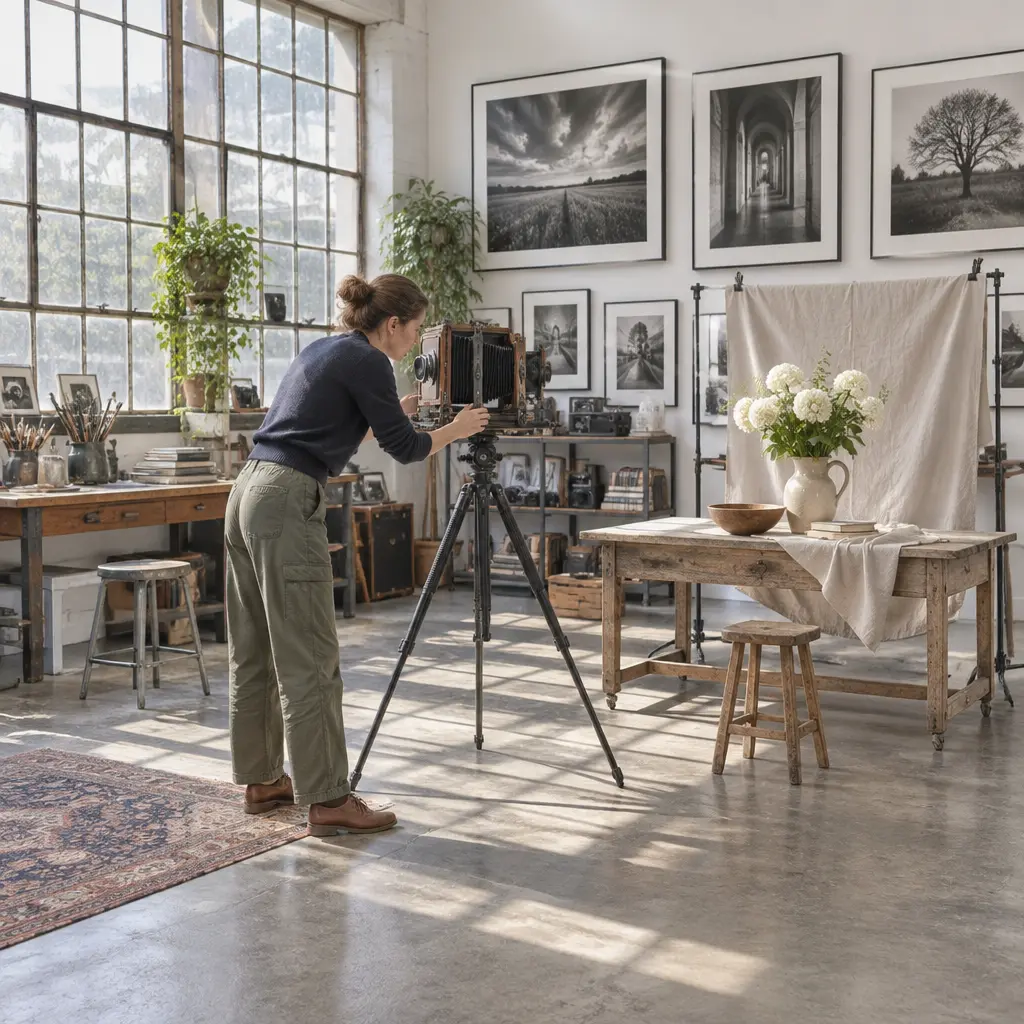
Photography is the process of making images by recording light, but its status as art was debated almost from the moment the medium appeared. Photography became established as a fine art gradually—not on a single date—through nineteenth-century experiments in artistic expression, influential exhibitions and publications, and the acceptance of photographs by museums and art institutions. The 1850s “art photography” movement, the pictorialist campaign of the late nineteenth century, Alfred Stieglitz’s influential Little Galleries of the Photo-Secession, and the Museum of Modern Art’s 1937 photography department mark important stages. Together, they show how photography’s claim to art developed through changing ideas about authorship, technique, originality, and cultural recognition.
Photography’s Fine-Art Status Developed Over Time
Fine art photography is photography made and presented primarily for its expressive, conceptual, or aesthetic meaning, rather than chiefly to document an event or fulfill a practical commission. The definition is not based on a camera, process, or subject: a portrait, landscape, staged scene, or digitally constructed image can be fine art when its artistic purpose and context support that reading. The Metropolitan Museum of Art’s history of photography describes the medium as both a technology for recording the world and a means of artistic expression.
Photography’s transition into art was therefore a history of recognition, not a technical invention suddenly changing category. In 1839, French government officials publicly announced the daguerreotype process, helping establish photography as a reproducible means of making images. Within a few years, photographers were making portraits, architectural records, landscapes, and carefully composed scenes. The debate that followed—whether a mechanically produced image could express an artist’s choices—shaped photography’s later movements and institutions.
The timeline below is a useful guide, rather than a claim that any one milestone settled the question:
- 1839: The daguerreotype is publicly introduced in France, and photography enters public life.
- 1850s: Photographers such as Oscar Gustave Rejlander and Henry Peach Robinson use staged composition and combination printing to make images with narrative and artistic ambition.
- 1880s–1900s: Pictorialists advocate photography’s artistic standing through controlled printing, exhibitions, and organizations.
- 1902–1905: Alfred Stieglitz organizes the Photo-Secession and opens the Little Galleries of the Photo-Secession, later known as 291, in New York.
- 1937: The Museum of Modern Art establishes a photography department, a major sign of institutional recognition.
Artistic Intention and Photographic Authorship
Artistic intention is the photographer’s deliberate use of subject, framing, light, timing, process, and presentation to shape meaning. This is central to the fine-art claim because it places authorship in the choices made before, during, and after exposure—not merely in the camera’s mechanical recording. The National Gallery of Art’s account of photography emphasizes that photographs reflect decisions about what to include, when to make an exposure, and how to print and present the result.
This broad definition includes several overlapping forms. Art photography is an umbrella term for photographs created or selected as artworks. Pictorial photography describes a historical movement that emphasized atmosphere and painterly effects. Documentary photography records people, places, or events, but can also function as art through its structure and interpretation. Conceptual photography foregrounds an idea or system, while constructed photography stages or digitally builds a scene. These categories can overlap: a photograph may document a real place and still communicate an individual artistic vision.
Composition, Light, and the Photographer’s Choices
Composition is the arrangement of forms within the image, while lighting and exposure determine how those forms appear. Early photographers worked with lengthy exposures and light-sensitive materials that imposed practical constraints; those limitations made decisions about pose, setting, and timing especially visible. Later photographers used both technical precision and deliberate imperfection as expressive tools. The resulting image is not simply a neutral copy of a scene: the frame excludes as much as it includes, and the photographer’s timing can change the meaning of an event.
Printing, Manipulation, and the Meaning of Originality
A photograph’s artistic identity can also be shaped in the darkroom or during digital editing. In the nineteenth century, combination printing allowed photographers to assemble a single image from multiple negatives. Rejlander’s The Two Ways of Life (1857), a complex allegorical composition made from numerous negatives, demonstrated that photographs could be staged and constructed rather than simply taken in one exposure. Henry Peach Robinson’s Fading Away (1858) similarly used combination printing to create a carefully arranged narrative scene.
These practices challenged the idea that photography’s value depended on an untouched, automatic record. Contemporary art photography continues to raise questions about editing, staging, appropriation, and digital alteration. The relevant question is not simply whether an image was manipulated, but what the process contributes to its meaning and how honestly its context is presented.
Early Photographers Made the Case for Photography as Art
Early artistic photography emerged as photographers sought to distinguish expressive image-making from routine commercial or scientific uses. The distinction was contested: some critics argued that photography was primarily a mechanical aid, while photographers countered that art could lie in the selection and arrangement of material, not only in hand-drawn execution. Exhibitions, photographic societies, and illustrated books gave this argument a public platform.
Oscar Gustave Rejlander and Henry Peach Robinson
Rejlander and Robinson are associated with combination printing, a process that joined parts of several negatives into a single print. Their work showed that photographers could build elaborate narratives and allegories using photographic materials. Rejlander’s The Two Ways of Life was exhibited in 1857 and attracted attention for its scale and moral subject. Robinson’s writing, including Pictorial Effect in Photography (1869), argued that photographers could apply compositional principles associated with painting while adapting them to the camera.
Their images did not end the debate about photography’s artistic status. Instead, they made authorship harder to dismiss: the photographs required planning, selection, technical labor, and decisions about how viewers would read a scene.
Julia Margaret Cameron and Expressive Portraiture
Julia Margaret Cameron used portrait photography to pursue psychological and literary expression. She often worked with soft focus, close framing, and sustained poses, techniques that departed from the sharply detailed commercial portrait conventions of her time. Her portraits of writers, scientists, family members, and friends treated the sitter as more than a record of appearance; gesture, lighting, and atmosphere helped construct a character.
Cameron’s example also illustrates why technical perfection is not the sole measure of artistic success. Effects that some contemporaries regarded as flaws could serve as deliberate expressive choices. Later museum collections and photography histories have helped establish her as a major figure in the medium’s artistic development.
Pictorialism Turned Artistic Recognition into a Movement
Pictorialism was an international movement, strongest from the 1880s into the early twentieth century, that argued photographs could be judged as works of art. Pictorialists often favored soft focus, atmospheric subjects, careful printing, and processes that gave the print a distinctive surface. Rather than treating these effects as a simple imitation of painting, they used them to emphasize mood, personal interpretation, and the photographer’s hand.
The movement organized its case through clubs, journals, salons, and exhibitions. The Royal Photographic Society and the Linked Ring in Britain, along with groups in Europe and North America, created communities where photographers could display work and debate standards. Alfred Stieglitz’s journal Camera Work, published from 1903 to 1917, reproduced photographs and essays that brought the movement’s arguments to an international audience.
The Photo-Secession and Stieglitz’s Galleries
Stieglitz founded the Photo-Secession in 1902 to promote photography as an independent art and to challenge restrictive exhibition practices. In 1905, he opened the Little Galleries of the Photo-Secession at 291 Fifth Avenue in New York. The space became known as 291 and presented photography alongside modern art, helping audiences encounter the medium within a wider artistic conversation.
Stieglitz’s importance extended beyond his own photographs. As an editor, organizer, gallery director, and advocate, he helped build the networks through which photographs could be exhibited, discussed, collected, and understood as art. The gallery also showed that photographic recognition depended on cultural institutions and critical writing as well as on image-making itself.
From Pictorial Softness to Straight Photography
By the early twentieth century, some photographers rejected Pictorialism’s painterly effects and argued for a more direct photographic approach. “Straight photography” valued clarity, precise focus, and the medium’s distinct ability to describe form and detail. Photographers such as Paul Strand and, later, members of Group f/64—including Ansel Adams and Edward Weston—helped make sharp focus and carefully controlled printing part of photography’s artistic vocabulary.
This shift did not mean that one style replaced art with another. It broadened the argument: a photograph could be artistic because of its unembellished precision as well as because of its painterly interpretation. Fine-art photography developed through this continuing debate over what the medium could do on its own terms.
Museums and Art Institutions Confirmed Photography’s Place
Museum recognition helped make photography a durable part of art history. The Museum of Modern Art in New York created a photography department in 1937 and appointed Beaumont Newhall as its first curator. The department’s creation mattered because it treated photographs as objects that could be collected, conserved, researched, exhibited, and interpreted within a major modern-art museum.
Institutional acceptance did not erase photography’s practical roles in journalism, science, advertising, or family life. Instead, it demonstrated that a medium used for many purposes could also produce artworks. Museum exhibitions and collections have since included a wide range of photographic practices, from historical processes and documentary projects to contemporary installation and digital image-making.
A related measure of the medium’s scale is the volume of images made. Photographic research firm Keypoint Intelligence estimated that approximately 1.6 trillion photos would be captured worldwide in 2023, largely through smartphones. This figure does not measure fine art, but it underscores the distinction between photography as a ubiquitous image-making technology and photography as a selected, authored, and culturally interpreted artwork.
How to Recognize Fine Art Photography Today
Fine art photography today is not defined by a single visual style or by the use of film rather than digital technology. Curators, critics, and viewers commonly consider the image’s intention, formal choices, relationship to a body of work, presentation, and context. These factors help explain why the same subject can appear in a news photograph, a commercial image, or an artwork without the subject alone determining its category.
Purpose and Context
Purpose concerns what the image is meant to do; context concerns how it is presented and understood. A photograph made for a newspaper may later be exhibited as art, while a staged photograph may address political or historical realities. Gallery display, a book sequence, an artist’s statement, and a museum label can all influence interpretation, although institutional presentation alone does not guarantee artistic significance.
Series, Sequencing, and Projects
Many contemporary photographers create projects rather than isolated images. A sequence can develop a visual argument, revisit a place over time, or connect personal experience to wider social questions. Photobooks and installations are especially important formats because they allow photographs to interact through order, scale, text, and physical display.
Process and Presentation
Process includes the camera or image-making method, editing, printing, and decisions about whether an image is unique or part of an edition. Presentation includes the print’s size, material, framing, and installation. These details can affect how viewers encounter an image, but no one process—such as a darkroom print or a large digital print—automatically makes a photograph fine art.
Conclusion: Photography Became Art Through Practice and Recognition
Photography did not become art at one precise moment. Its artistic status grew through early experiments in composition and combination printing, Cameron’s expressive portraits, the Pictorialists’ exhibitions and publications, Stieglitz’s Photo-Secession and 291 gallery, the rise of Straight photography, and museum recognition—especially MoMA’s photography department in 1937. Each stage expanded the understanding of photographic authorship and what a photograph could communicate.
The history remains relevant because photography is now both an everyday technology and a global art form. When looking at photographs, consider who made the image, what choices shaped it, how it is presented, and what ideas or experiences it invites viewers to consider. For further study, explore the photography collections and historical essays of the Metropolitan Museum of Art, the National Gallery of Art, and the Museum of Modern Art.
Sources: The Metropolitan Museum of Art, “Heilbrunn Timeline of Art History: Photography,” https://www.metmuseum.org/essays/photography; National Gallery of Art, “Photography,” https://www.nga.gov/artists/photography.html; Museum of Modern Art, “The History of Photography at MoMA,” https://www.moma.org/collection/terms/photography; Victoria and Albert Museum, “The Art of Photography,” https://www.vam.ac.uk/articles/the-art-of-photography; Tate, “Pictorialism,” https://www.tate.org.uk/art/art-terms/p/pictorialism; Keypoint Intelligence, “1.6 Trillion Photos to Be Taken in 2023,” https://keypointintelligence.com/news/1-6-trillion-photos-to-be-taken-in-2023