
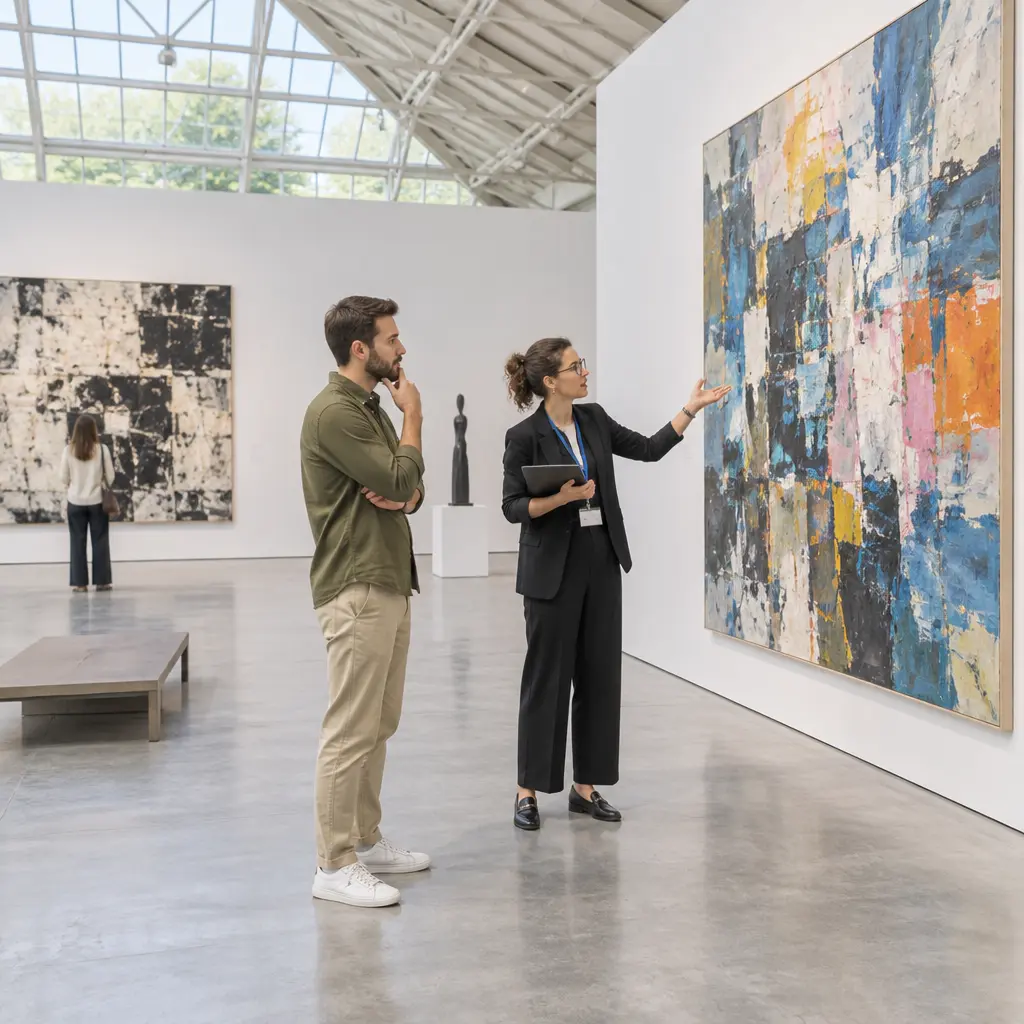
Globalization changed the art world by expanding the movement of artworks, artists, money, ideas, and audiences across national borders. Here, the “art world” means the connected institutions and people involved in making, exhibiting, collecting, and interpreting art. International biennials, online platforms, global auctions, and migration have widened access and influence, while also intensifying debates about unequal representation, cultural ownership, and market power. The scale is visible in the commercial market: the 2024 Art Basel and UBS Global Art Market Report estimated global art sales at US$57.5 billion in 2023, down 4% from 2022, illustrating both the reach and volatility of cross-border trade. This article examines how globalization reshaped artistic exchange, institutions, the market, and cultural politics—and why those changes matter.
Globalization reshaped the art world through cross-border exchange
Globalization is the intensification of connections among countries and communities through trade, migration, communication, technology, and cultural exchange. Applied to art, it describes the growing circulation of artists, artworks, ideas, funding, and audiences across borders. Rather than simply making art more international, globalization changed who could participate, where artistic authority was located, and how art was valued.
The process has several related forms: the internationalization of exhibitions and museums; the globalization of art commerce; the circulation of artistic styles and knowledge; and the digital distribution of images and events. These developments overlap, but they do not create an evenly balanced global system. Wealthy collectors, major auction houses, influential museums, and well-connected cities still have disproportionate power to set prices and shape visibility.
From national art histories to interconnected networks
For much of the modern period, influential art histories were organized around national schools and Western European or North American institutions. Globalization encouraged curators, scholars, and artists to examine connections among regions, including colonial histories, migration, trade, and cultural exchange. The result is not the disappearance of local traditions, but a greater recognition that artistic movements often develop through contact across borders.
The 1989 exhibition “Magiciens de la Terre” at the Centre Pompidou and Grande Halle de la Villette in Paris is often discussed as an early, influential attempt to place contemporary artists from different parts of the world in a shared exhibition. It also drew criticism for the unequal framing of artists and for treating cultural contexts differently. The example shows that international visibility can challenge narrow art histories while still reproducing hierarchies.
A global system with uneven influence
Global connection does not mean equal access. Institutions in major financial and cultural centers often have greater resources for acquisitions, exhibitions, publicity, and art-market transactions. Artists from outside those centers may gain international exposure, but may also be expected to represent a simplified idea of their region or identity. Researchers and cultural organizations therefore distinguish between global reach and genuinely equitable participation.
International exhibitions expanded the art world’s institutions
International exhibitions are temporary or recurring presentations that bring artists, curators, and audiences from different countries into a shared setting. Biennials and triennials are important examples. They provide platforms for new work, build professional networks, and can give host cities international cultural visibility. Their growth has helped move contemporary art beyond a small number of established museum centers.
Biennials and triennials as meeting points
The Venice Biennale, founded in 1895, is among the longest-running international art exhibitions. Later events—including the São Paulo Biennial, founded in 1951, and the Dakar Biennale, founded in 1990—created additional platforms with distinct regional histories and priorities. Such events connect artists and institutions, but their influence depends on who curates them, which artists receive resources, and whether local audiences are meaningfully involved.
The biennial model also changed how cities use culture. Hosting a major exhibition can support tourism, civic branding, and investment in cultural infrastructure. At the same time, critics ask whether short-term cultural prestige benefits local communities or primarily serves real-estate development and international visitors. These questions make biennials both artistic forums and sites of political and economic negotiation.
Museums, curators, and changing representation
Museums have responded to globalization through international acquisitions, touring exhibitions, partnerships, and revised displays of their permanent collections. Curators increasingly address migration, colonialism, diaspora, and transnational identities. This work can broaden public understanding, but representation alone does not resolve questions about ownership, restitution, or who controls institutional narratives.
The International Council of Museums adopted a new museum definition in 2022, describing museums as institutions that research, collect, conserve, interpret, and exhibit tangible and intangible heritage, while emphasizing accessibility, inclusivity, sustainability, and community participation. The definition reflects changing expectations for museums in a globally connected society: institutions are asked not only to display objects, but also to explain their histories and relationships with communities.
Global art markets connected commerce and cultural value
The global art market is the network of dealers, galleries, auction houses, art fairs, collectors, advisers, and online platforms through which art is bought and sold. Globalization expanded this network by enabling transactions across borders and attracting buyers in new regions. Market growth can provide artists and galleries with wider opportunities, but prices and visibility remain concentrated among a relatively small number of artists and institutions.
Sales, trade, and market volatility
The Art Basel and UBS Global Art Market Report estimated that worldwide art sales reached US$57.5 billion in 2023, a 4% decline from 2022. The report also estimated dealer sales at US$36.1 billion and public auction sales at US$25.1 billion; these channel estimates use separate reporting and should not be added as though they were a single reconciled total. The figures illustrate the market’s scale, while the annual decline shows its sensitivity to economic conditions, geopolitical uncertainty, and changes in high-value buying.
Art fairs are another feature of this connected marketplace. Events such as Art Basel, Frieze, and Art Dubai bring galleries and collectors together, often within a few days. They can help galleries reach international clients and introduce artists to new audiences, but travel, booth fees, and logistics can make participation difficult for smaller organizations. As a result, global circulation can reproduce economic barriers even as it expands the market.
New collecting centers and cultural influence
Economic growth and cultural investment in parts of Asia, the Middle East, and Latin America have helped create new collecting centers and major institutions. This has diversified the geography of patronage, although the global market remains uneven and its rankings depend on how sales are measured. New centers can support local artists and collections, while also competing for international exhibitions, museum professionals, and high-profile works.
The market’s international character also raises questions about cultural property. UNESCO’s 1970 Convention addresses the means of prohibiting and preventing the illicit import, export, and transfer of ownership of cultural property. Its existence reflects a central tension in globalization: artworks can circulate widely, but movement may involve theft, colonial extraction, illegal excavation, or disputed ownership. Provenance research and transparent acquisition policies are therefore essential parts of responsible collecting.
Digital globalization changed access and artistic practice
Digital globalization is the cross-border circulation of art and cultural information through the internet, social media, streaming, and digital collections. It allows artists to share work without relying exclusively on galleries or museums, and lets audiences encounter exhibitions from distant locations. It also changes how art is documented, promoted, discussed, and sometimes sold.
Online visibility and virtual exhibitions
Museum websites, online viewing rooms, and virtual tours expanded during the COVID-19 pandemic, when many physical venues closed. These tools can make collections accessible to people unable to travel and help institutions reach international audiences. However, digital access depends on reliable internet, devices, language access, and accessible design; a virtual exhibition is not an equal substitute for physical access or local cultural programming.
Social platforms also let artists circulate images and build audiences directly. This can reduce dependence on traditional gatekeepers, but visibility is shaped by platform algorithms, advertising, and the ability to produce frequent content. The online art world therefore has its own forms of concentration and labor: artists may gain reach while receiving little compensation for the circulation of their work.
Digital art, NFTs, and questions of ownership
Networked and software-based art use digital systems as part of the artwork, while non-fungible tokens (NFTs) are blockchain records that can be associated with digital items. The NFT boom of 2021 brought new attention to digital art and speculative collecting, but an NFT does not automatically establish copyright ownership or guarantee the authenticity of the associated work. The episode demonstrates how technology can create new routes to market while leaving legal, environmental, and economic questions unresolved.
Digital preservation is another challenge. Websites, software, interactive installations, and platform-based works can become inaccessible when hardware, file formats, or services change. Museums and archives must therefore preserve not only an image of a work, but sometimes its software, documentation, and operating conditions.
Migration and exchange diversified artistic ideas
Migration and diaspora have shaped art through the movement of people, languages, memories, and techniques. Artists who live or work across countries may draw on multiple cultural contexts without fitting neatly into a national category. Their practices reveal globalization not only as the circulation of objects and money, but as lived experience involving displacement, adaptation, and belonging.
Diaspora, identity, and hybrid practice
Diasporic art often addresses memory, migration, language, and the relationship between a place of origin and a place of residence. These themes do not define every artist with a migration background; artists should not be reduced to biographies or expected to speak for entire communities. A more nuanced approach recognizes that cultural identity can be multiple, changing, and shaped by personal choices as well as political circumstances.
Transnational exchange can also influence materials and forms. Artists may combine local techniques with global media, collaborate with practitioners in other countries, or respond to international events. Such practices complicate the idea that artistic styles belong exclusively to one nation and encourage art histories that trace relationships rather than isolated national traditions.
Cultural appropriation and unequal exchange
Cultural appropriation debates concern the use of cultural forms, symbols, or knowledge by people outside the communities associated with them, especially where power and benefit are unequal. Global visibility can encourage respectful collaboration and exchange, but it can also allow powerful institutions or artists to profit from cultural material without consent, credit, or compensation. Context, attribution, community participation, and the history of colonial relations all matter when evaluating a specific case.
These debates connect directly to restitution and provenance. Museums and collectors increasingly face calls to investigate how objects entered their collections and whether they should be returned. The issue is not simply whether art should cross borders; it is whether movement was lawful and ethical, and whether source communities have a meaningful role in decisions about their heritage.
Conclusion: globalization made the art world broader and more contested
Globalization transformed the art world by expanding international exhibitions, connecting markets, accelerating digital circulation, and bringing migration and cultural exchange into sharper focus. Biennials and museums widened institutional networks; the art market reached tens of billions of dollars in annual sales; and online platforms created new forms of access and visibility. These changes have diversified artistic conversations, but they have not eliminated inequalities in money, representation, ownership, or influence.
Understanding the global art world requires asking not only what travels, but who controls that movement, who benefits, and whose histories are heard. Readers can explore museum collection policies, biennial programs, and provenance research to assess how institutions address these questions. Artists, collectors, and audiences can support transparent, locally engaged, and ethically sourced cultural work.
Sources: Art Basel and UBS, The Art Market 2024, https://www.artbasel.com/about/initiatives/the-art-market; International Council of Museums, Museum Definition, https://icom.museum/en/resources/standards-guidelines/museum-definition/; UNESCO, 1970 Convention on the Means of Prohibiting and Preventing the Illicit Import, Export and Transfer of Ownership of Cultural Property, https://www.unesco.org/en/legal-affairs/convention-means-prohibiting-and-preventing-illicit-import-export-and-transfer-ownership-cultural; Centre Pompidou, Magiciens de la Terre, https://www.centrepompidou.fr/en/program/calendar/event/cn4M8M; La Biennale di Venezia, History of the Biennale, https://www.labiennale.org/en/history; Bienal de São Paulo, History, https://bienal.org.br/en/about/; Dak’Art, Biennale de l’Art Africain Contemporain, https://biennaledakar.org/