
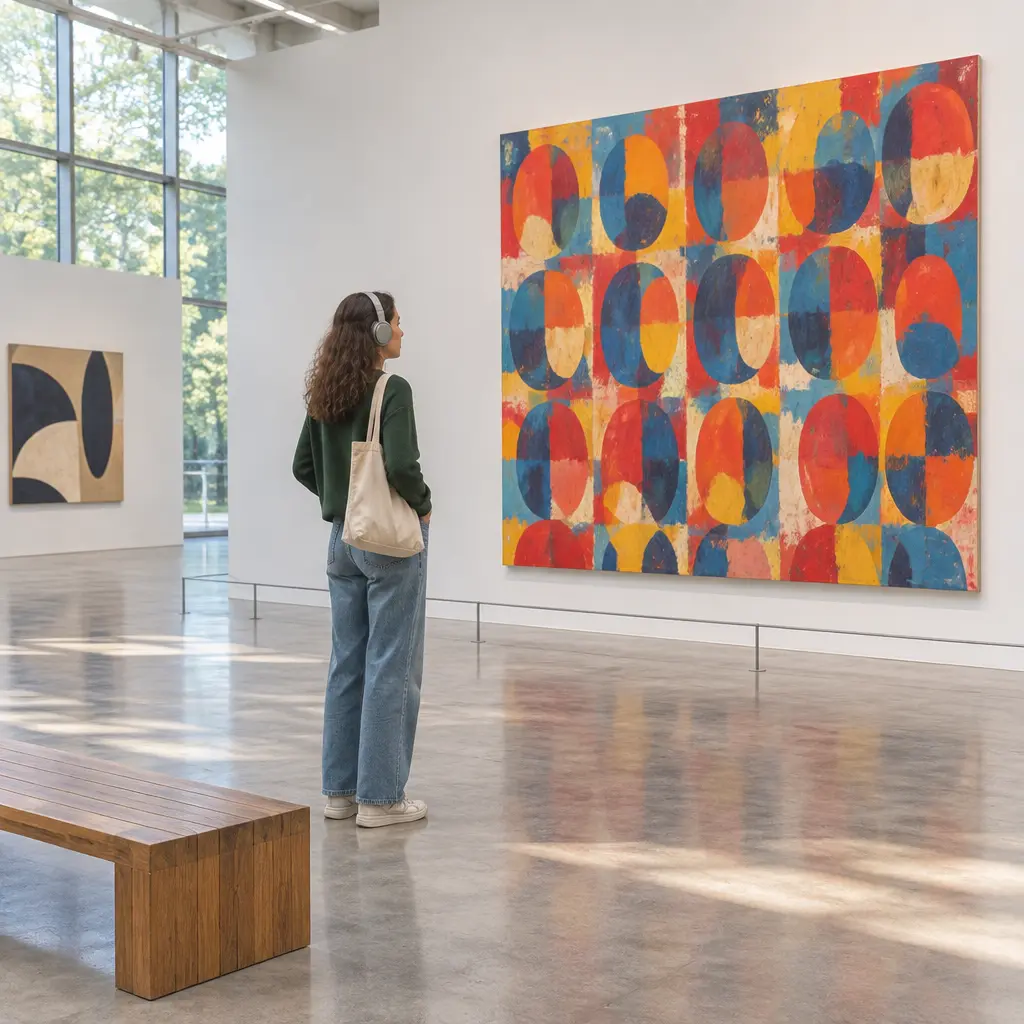
Music and visual art influence each other by translating shared elements—such as rhythm, color, pattern, movement, and emotion—across sound and image. Artists have long used musical structure to shape visual compositions, while musicians have drawn on paintings, design, and performance to inspire sound. This exchange appears in historical movements such as Impressionism and Abstract Expressionism, in modern music videos and digital installations, and in research on how people perceive sound and color. Understanding the relationship reveals how creative disciplines borrow from one another and why combinations of sound and image can make artistic experiences especially vivid.
How Music and Visual Art Influence Each Other Through Shared Structure
Music and visual art are distinct art forms, but both organize elements over time or space to create patterns and meaning. Music arranges pitch, duration, timbre, and silence; visual art arranges line, color, shape, texture, and space. Art historian and theorist Wassily Kandinsky argued in Concerning the Spiritual in Art that color and form could function like musical tones, producing emotional effects through their relationships. His account is an influential artistic theory, not a claim that every color has one universal musical equivalent.
The connection is important in both art history and contemporary culture. The National Endowment for the Arts’ 2022 Survey of Public Participation in the Arts found that 48% of U.S. adults attended a live music, dance, or theater event during the previous year, while 21% visited an art exhibit or gallery. These activities can overlap, and music is also embedded in film, games, exhibitions, and online media, where sound and image are designed to work together. The sections below examine structural parallels, historical exchange, cross-sensory perception, and contemporary examples.
Shared Structure Defines Music and Visual Art’s Formal Influence
A useful definition of this relationship is the exchange of compositional principles between sound-based and image-based art. In Kandinsky’s account, a visual composition could be understood as an arrangement of “inner” forces comparable to musical harmony and rhythm. More broadly, artists and scholars describe this as cross-disciplinary influence: one medium supplies structures, metaphors, or techniques that another medium adapts. The borrowing is often suggestive rather than literal; a painted rhythm is not sound, but repeated visual forms can evoke pacing or emphasis.
Rhythm, Repetition, and Visual Pattern
Rhythm is the organization of events into patterns of recurrence and variation. In music, it is heard through timing and accent; in visual art, it can be suggested by repeated marks, shapes, colors, or figures. Repetition creates expectation, while changes in scale, spacing, or intensity can resemble syncopation or a shift in musical emphasis. Bridget Riley’s Op Art compositions, for example, use repeated geometric patterns and carefully controlled variation to produce a sense of optical movement. The viewer does not hear the work, but its visual sequence can feel rhythmic.
Harmony, Color, and Composition
Harmony describes how elements relate within a whole. In music, it concerns the combination and progression of pitches; in visual composition, balance among colors, shapes, and spatial relationships can produce a comparable sense of unity or tension. The analogy has limits: color and pitch do not map onto one another in a single agreed system. Still, artists have used musical language to discuss visual balance, contrast, and resolution. Kandinsky’s paintings, including Composition VII (1913), combine forms and colors in arrangements intended to suggest movement and emotional intensity rather than depict a recognizable scene.
Tempo, Movement, and Visual Sequencing
Tempo is the speed of a musical pulse; visual art can imply speed through direction, repeated forms, blurred contours, or the arrangement of images in a sequence. Futurist artists made motion and modern life central subjects, while film and animation can synchronize visual change with musical timing. In a gallery, a slowly unfolding video installation may invite a different pace of attention than a rapid montage. These examples show how temporal ideas move from music into visual art and how visual sequencing, in turn, can shape musical composition.
Historical Movements Demonstrate Music and Visual Art’s Exchange
The formal parallels between music and image became especially visible in movements that challenged traditional representation. Artists began treating color, line, and shape as independent expressive materials, much as composers could organize sound without relying on familiar melodies. This shift developed alongside new technologies and changing ideas about perception, creating a bridge from historical experiments to present-day audiovisual work.
Impressionism and the Visual Translation of Musical Ideas
Impressionism is best known as a visual movement concerned with light, atmosphere, and transient effects, but the name also belongs to a major musical movement associated with composers such as Claude Debussy. The two fields were not identical, yet they shared an interest in suggestion, nuance, and shifting sensory impressions. Debussy’s orchestral work La Mer (1905) evokes changing seascapes through coloristic orchestration, while painters such as Claude Monet explored changing light across repeated views. The comparison illustrates a shared artistic concern, rather than direct proof that one work simply caused the other.
Kandinsky, Abstraction, and the Idea of “Painting Music”
Kandinsky is a central example of an artist who treated music as a model for abstraction. He believed that color and form could communicate emotional and spiritual experience without depicting objects. His titles—including Improvisation and Composition—borrow musical terms, signaling an interest in structure and expressive freedom. The Guggenheim Museum’s account of Kandinsky’s practice places his work within the development of abstraction, where nonrepresentational forms became capable of carrying meaning in their own right.
Abstract Expressionism and Jazz
Abstract Expressionism developed in postwar New York and is often associated with gesture, scale, and spontaneity. Critics and artists have compared its improvisational qualities with jazz, particularly in the work of painters such as Jackson Pollock. This is a useful interpretive connection, not a claim that a painting reproduces a particular jazz performance. Both practices can involve structured freedom: an artist or musician works within a medium’s possibilities while responding to decisions made in the moment. The Smithsonian American Art Museum’s discussions of postwar American art place these painters in a period when abstraction became a major international force.
Cross-Sensory Perception Connects Music and Visual Art
Historical analogies are reinforced by research into how people associate sound with visual qualities. Cross-sensory perception refers to the way information from one sense can influence or correspond with another. Some associations are common across groups, while others reflect individual experience, culture, or learned convention. Research in this area helps explain why artists can create convincing audiovisual correspondences without assuming that all audiences perceive them identically.
Sound–Color Associations and Synesthesia
Synesthesia is a perceptual condition in which stimulation in one sensory domain is consistently accompanied by an additional experience, such as seeing colors when hearing particular sounds. It is different from the more widespread tendency to associate high-pitched sounds with brightness or particular musical moods with colors. Neuroscientist and synesthesia researcher Jamie Ward has described synesthesia as a family of unusual cross-sensory experiences rather than one single phenomenon. Because synesthetic associations vary among individuals, artists should treat them as personal material, not universal rules.
Research on Matching Music and Images
Studies of cross-modal matching ask people to pair sounds with colors, shapes, or movement. Research by psychologists Stephen E. Palmer, Karen B. Schloss, and colleagues has found that people often show systematic preferences when matching music and color, with emotional qualities such as happiness or sadness helping explain the choices. Such findings support the idea that some audiovisual correspondences are shared, but they do not establish a fixed code in which a given note always equals a particular color. A chart comparing musical mood with color choices can illustrate these trends, provided it is labeled as a group-level tendency rather than a universal translation key.
Emotion as a Bridge Between Sound and Image
Emotion can link music and visual art even when their formal elements do not match. A slow tempo, low register, and subdued dynamics may be paired with dim light, muted color, or sparse imagery to reinforce a reflective mood. Conversely, a rapid beat and bright visual palette can create an impression of energy. Film scoring uses this relationship extensively: music can guide interpretation of a scene, while visual context can change how a musical passage is understood. The effect depends on cultural conventions and context as well as on the properties of sound and image.
Contemporary Media Apply Music and Visual Art’s Shared Language
Today, the exchange between music and visual art is built into many forms of popular and fine art. Music videos, live visuals, interactive installations, and digital tools make sound-image relationships central to the work rather than an analogy added afterward. These formats also make collaboration more common, with musicians, directors, designers, animators, and programmers shaping a single audience experience.
Music Videos and Visual Identity
A music video is an audiovisual work that interprets or extends a musical track through moving images. It may tell a story, build an artist’s visual identity, or translate musical features into editing, choreography, color, and camera movement. MTV’s launch in 1981 helped establish the music video as a major promotional and creative format, while online platforms later made video distribution global and on demand. A useful case study is Beyoncé’s Lemonade (2016), which combined music, poetry, fashion, landscape, and visual symbolism into a connected film-length presentation.
Live Visuals and Installation Art
Live visuals are images generated, selected, or manipulated in response to music during performance. They range from projected shapes and lighting to complex digital environments synchronized with sound. In installation art, the audience may move through a space where sound, light, and image are designed together. The work of teamLab, for example, uses digital projection and responsive environments to make viewers’ movement part of the visual experience. These projects extend the traditional artwork beyond a fixed canvas and invite audiences to experience composition spatially and temporally.
Digital Tools and Collaborative Creation
Digital audio workstations, animation software, projection mapping, and generative systems allow artists to coordinate sound and image with precision. A sound waveform can trigger changes in color or motion, while visual timing can guide a composer’s arrangement. These tools lower some barriers to experimentation, although access to equipment, training, and production resources remains uneven. The result is a broad range of work, from small independent music videos to large-scale immersive exhibitions, in which music and visual design are developed as connected parts of one composition.
Conclusion: Music and Visual Art Expand Each Other’s Possibilities
Music and visual art influence each other through shared structures, historical exchange, cross-sensory perception, and contemporary audiovisual practice. Rhythm can become repetition; harmony can become visual balance; musical mood can shape color and movement. Kandinsky’s abstract paintings, jazz comparisons in Abstract Expressionism, research on sound–color matching, and modern music videos all show different forms of this relationship. The evidence also cautions against treating artistic correspondences as universal formulas: perception varies, and context matters.
This exchange matters because it broadens how people create, interpret, and experience art. To explore it further, compare a musical passage with a painting, attend an exhibition that uses sound, or notice how a film’s soundtrack changes the meaning of its images. Observing these connections can make familiar works feel newly complex and can encourage more collaboration across artistic disciplines.
Sources: National Endowment for the Arts, 2022 Survey of Public Participation in the Arts, https://www.arts.gov/impact/research/publications/2022-survey-public-participation-arts; Wassily Kandinsky, Concerning the Spiritual in Art, https://www.gutenberg.org/ebooks/5321; Solomon R. Guggenheim Museum, Kandinsky, https://www.guggenheim.org/artwork/artist/wassily-kandinsky; Smithsonian American Art Museum, Abstract Expressionism, https://americanart.si.edu/artwork/movement/abstract-expressionism; Jamie Ward, Synesthesia, https://www.sussex.ac.uk/synaesthesia/; Stephen E. Palmer, Karen B. Schloss, Zoe Xu, and Lilia R. Prado-León, Music–Color Associations Are Mediated by Emotion, Proceedings of the National Academy of Sciences, https://www.pnas.org/doi/10.1073/pnas.1212562110; teamLab, About teamLab, https://www.teamlab.art/about/